
Oracle is replacing the engine that runs every HFM rule file. Your rules can stay as they are, but you need to prove they still produce the same numbers.
Rules are what make HFM a consolidation engine.
Every financial reporting manager knows that a close application is only as good as its rules. Rules derive, calculate, eliminate and validate data in the underlying data store. They handle cash flow, currency translation adjustments, minority interest, opening balances and the many group-specific adjustments that make your consolidation yours.
In Oracle Hyperion Financial Management (HFM), those rules have always been written in VBScript, Microsoft’s lightweight scripting language based on Visual Basic. It is readable and forgiving, and for more than two decades it worked well. HFM loads the rules file and calls the right subroutine at each point in the calculation, translation and consolidation process.
Accuracy is not understanding
Microsoft is deprecating VBScript and will eventually remove it from Windows. The main reason is that VBScript is now used more often by attackers than by legitimate users, creating a significant security risk. Microsoft points customers to modern tools such as PowerShell, but nobody wants to rewrite consolidation rules in PowerShell.
Oracle’s answer is to stop relying on Microsoft’s engine altogether. It has built its own engine, which reads the same VBScript syntax directly into HFM. The language it runs is called Financial Management Business Script Language (BSL), and the engine is the Native Script Engine.
In short, your rules stay as they are while Oracle’s engine runs them instead of Microsoft’s.
What it means for you
This is a stated product direction, not just a technical option. In the EPM 11.2.26 readme, Oracle explains that the Native Script Engine becomes the default in release 11.2.31 (October 2027), while the Microsoft engine moves to critical fixes only. Then, in release 11.2.39 (October 2029), Microsoft’s engine is removed completely.
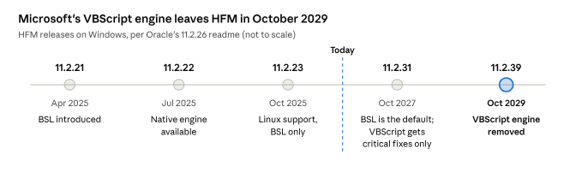
HFM script engine timeline · 5 releases
Two points should shape your planning:
- Linux runs on BSL only. From release 11.2.23, HFM on Linux supports only the Native Script Engine. Any move off Windows servers is a move to BSL.
- The dates can shift. Oracle says it will align with Microsoft’s VBScript timeline, and it has already moved these dates once. Plan on the current dates and treat any extra time as a bonus.
What to do next
Switching engines takes one setting. The real effort is proving that your existing rules, member lists and logic behave exactly as before under BSL.
BSL supports most of VBScript, but not all of it. Rule files that have grown over many years often contain constructs outside BSL’s documented scope. Oracle provides no automated converter, so every rule file needs reviewing.
Oracle’s recommended process is:
- Copy the application into a test environment.
- Switch the engine by setting ScriptEngineType=0.
- Open the application and fix any rule or member list errors so the scripts are within BSL scope.
- Log anything out of scope with Oracle, which will fix it, offer a workaround or suggest an alternative.
- Run everything that triggers rules and lists: consolidations, on-demand rules and dynamic member lists.
- Validate the data and confirm every process completes.
- Promote the changes to your other environments.
We add one step to step 6: a parallel-run comparison. Consolidate the same periods under both engines and compare the results line by line. An application that loads cleanly has not yet proven it produces identical numbers.
How Futuresense can help
As South Africa’s leading Hyperion and Oracle EPM systems integrator, Futuresense supports customers across the full application lifecycle, from advisory and architecture to implementation, remediation and application management. We help you with where you are today and where you are heading.
For BSL, that means a structured readiness assessment: we scan your rule and member list files for out-of-scope constructs, fix them, and run the parallel comparison before anything reaches production. If you are also weighing a move to Oracle FCCS, it is worth asking whether the same testing effort is better spent on migrating.
We’d be happy to walk you through what this means for your application, with an honest view of typical effort. No pitch, just a practical conversation. Is that worth 30 minutes of your time? Contact us to book a session.